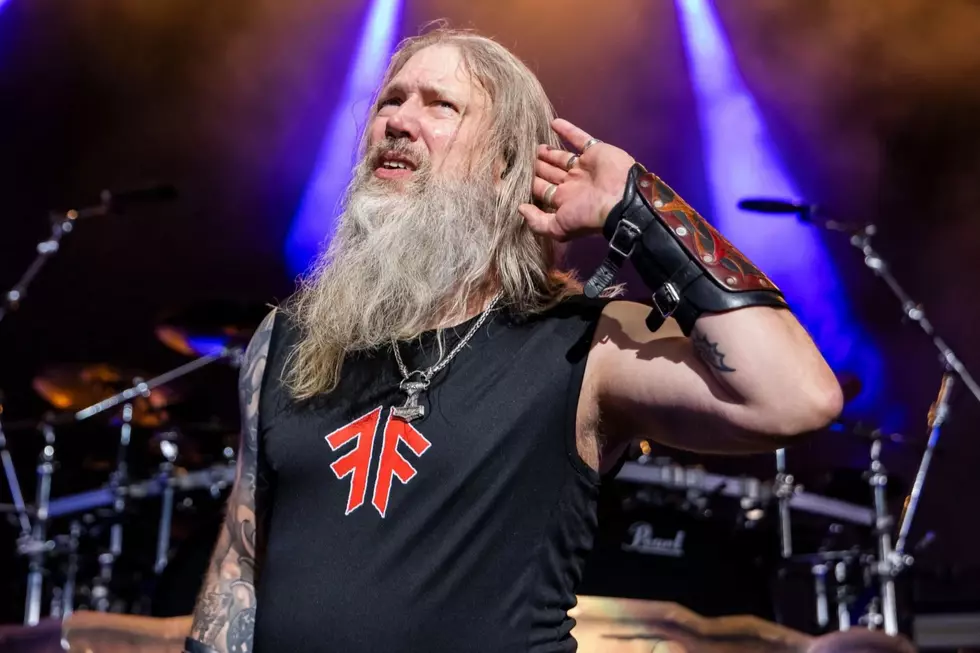
Amon Amarth’s Johan Hegg Shares the Paradox of Character That Inspired ‘The Allfather Awakens’
The Norse deity Odin has been a popular topic for Amon Amarth over the years, but singer Johan Hegg tells Full Metal Jackie that their latest album, The Allfather Awakens, looks at Odin from a new perspective.
In speaking with the radio host for her weekend radio show, Hegg confessed the idea started with historian Neil Price, who pointed out the paradox of Odin in that vikings are thought to be part of a violent society but Odin was more frequently "a god of the mind."
"Odin more than anything seeks knowledge and wisdom. That's what he wants more than anything. And he's willing to give a lot, even sacrifice his own life to get it," says Hegg. "So, for this album, that's kind of the image I wanted to show about Odin because he's not necessarily a benevolent god. He's actually kind of scary in many ways 'cause, I mean, he will even murder to, to get what he wants. But he is a god of the mind and he worries about the future, he worries about his people and his creation. So he wants to know how to save it from the end, which is Ragnarok."
Within the chat, Hegg also discusses their recording process helping to focus their music, the sacrifice that goes into being in a band and why putting the messaging on the search for knowledge and wisdom meant something to him.
He also spoke about taking on an acoustic song for the first time in their career and the creative spirit that permeated their summer touring with Dethklok and Castle Rat. Check out more of the chat below.
It's Full Metal Jackie and it is always a pleasure to welcome back to the show Amon Amarth frontman, Johan Hegg. Amon Amarth are back with The Allfather Awakens, which is once again a reference to Odin, the Norse deity that has served as such a big muse in your career. What first drew your interest in Odin and what has made it such a rich source of inspiration for the band?
Well, obviously Odin is one of the main characters in the Norse god pantheon. There are so many stories about him, which we've explored before, especially also, like the relationship that the Vikings had to Odin and stuff like that.
Actually for this album I wanted to explore what really actually is an idea that came from Neil Price, one of the most prominent historians and archeologists when it comes to the Viking age. He said to me that it's fascinating that Odin, considering how violent the Vikings were and how violent the society of the Vikings were, that their chief god is really a god of the mind. And he's absolutely right.
It's really interesting because Odin more than anything seeks knowledge and wisdom. That's what he wants more than anything. And he's willing to give a lot, even sacrifice his own life to get it. So, for this album, that's kind of the image I wanted to show about Odin because he's not necessarily a benevolent god. He's actually kind of scary in many ways 'cause, I mean, he will even murder to, to get what he wants. But he is a god of the mind and he worries about the future, he worries about his people and his creation. So he wants to know how to save it from the end, which is Ragnarok.
Amon Amarth, "Eight Legs of Thunder"
I wanna talk about that track we played before which is called "Eight Legs of Thunder." The great thing with music is that it's open to interpretation. Johan, how enjoyable was it to see a, a more Western vibe depicted for that video? It definitely had a very cinematic feel to it.
I wish I could take credit for that, but that was actually a joint combination from Johan Söderberg, Olavi Mikkonen and the Group of Thirteen guys who kind of made that happen. I think it's hilarious. I think it's so much fun.
Johan, this new record was a bit of a different recording process for you. Each song individually treated as a single entity. Music first, lyrics later. How enjoyable did that make the process for you? Was it more of a challenge or did it bring something special to how this record turned out?
Recording-wise, we've kind of worked like that before, like, since, the Berserker album actually. That we record one song at a time, completely. Drums, guitars, bass, vocals and then we move on to the next one. And it's a really nice way to work because it gives you space to go back to the songs.
When you're done you can leave them be and you can go back and listen if there's anything that you feel like you wanna change or that you need to change to make the song work better. What was different this time around was that we also did a two session recording.
So we recorded six songs in March of 2025 and then we went back and recorded the rest of the songs in March of 2026. So that also gave us some room to think about the songs we already recorded and also gave us, I think more focus on the songs we were recording at the time. Because there's always gonna be a time during the recording where you kind of lose focus. You get almost a studio fatigue.
That's a long time. Did you feel differently about the songs hearing them a year later?
Actually, no, which is really interesting. I was really surprised that... Usually there's gonna be one or two songs where you go like, "Eh, could've done that differently." But I actually didn't feel that with these songs. So I think we did a really good job with them from the start. So there weren't a lot of changes. Maybe some minor details, but nothing major.
Johan, one of the lessons referenced on this record concerns sacrificing one's sight to gain a greater foresight. As an artist, do you have an experience in your career where making a sacrifice led you to something greater in the long run?
If you think about it, anything worth something in life, anything you wanna achieve in life, anything worth pursuing demands sacrifice. For us, it meant working full time, but every evening going to the rehearsal place, practicing our instruments and writing songs and we did that for years, so many years before we got to the point where we are today.
If you're an athlete, you have to make sacrifices if you wanna be professional. You have to sacrifice going out drinking with your friends because you have practice the next morning. You have to sacrifice staying up late because you have to go to bed because you have practice before you go to school the next day or something.
Anything worth pursuing in life takes sacrifice and there are no free meals, you know? think that's the idea behind the whole sacrificial thing. I mean, I don't claim to mean people to go stick out their eyes and think that you will get wisdom from it. But Odin, he traveled to the far end of the underworld to drink from the well of wisdom. And in order to do that he had to sacrifice his eye in the end. So it's one of those things.
And obviously for us, as I said before, we sacrificed a lot to get to where we are. We've had setbacks and we've went through tough times and all that stuff. But at the end of the day, if it's really worth pursuing, you will do it.
It's Full Metal Jackie. Johan Hegg from Amon Amarth with us again talking about The Allfather Awakens album. This record is not a concept album, but there's a bit of historical inspiration fueling the direction. Yet, the idea of sacrificing for the greater good is something that could be just as easily applied in a message much needed in today's world. Was there hope in creating this that some of the messaging could uplift and inspire listeners concerning what's going on in the world today?
I don't think that... I don't proclaim to have that power. From my point of view, I don't wanna tell people what to think. I wanna write inspiring stories that I find inspiring and hopefully somebody else will as well.
But I wanted to focus on the mind, the knowledge, wisdom and those types of things on this album because I think it's something that we kinda lost today.
READ MORE: The Best Album by 11 Legendary Death Metal Bands
I mean, we're getting lost in religious superstition again together with opinions rather than facts. I think Ricky Gervais said it really well. He said, like, "You can have your own opinions, just not your own facts." And people treat their opinions as if they're fact. I think it's something we need to find our way back from because it didn't used to be like that,
Facts used to be facts.
Yeah.
Johan, at 13 albums in, there's still some firsts for the band. Why at this point in your career was now the right time to deliver your first acoustic song in "Upphaf," and how did it come about? Was it too good to not to try it out at this point in time?
It's one of those things where I think Oli [Mikkonen[ had this idea for over a decade for this song. And usually when he has an idea that he doesn't think fits Amon Amarth, he will scrap it and just not do anything with it, but it kept coming back to him.
This time he decided to present the idea to us and we loved it, so we knew right away that it would be a great song to put on the album. So it's actually as easy as that.
It's the first time we really had a fully acoustic idea for a song to put on the album, so ...
Right, and then we were all like, "Is this an acoustic album?" You guys are like, "No, no, no."
Yeah. Yeah. A lot of... that. That was kind of the idea of by ...
Freaking people out?
Yeah putting it out first. See what we got, what kind of reaction we got from that. It was kind of fun.
Amon Amarth, "Upphaf"
Johan, the Amon Amarth stage is always one of the more entertaining things in music. I know you had the chance to do this this past summer, but I'm still wowed by the idea of the creativity involved in a tour pairing with Dethklok and Castle Rat. How enjoyable was it to see what everyone on that tour would bring nightly, and did you personally pick up anything creatively from how your support acts approached their shows?
Well, first of all, I thought it was amazing. I thought it was a great tour. I think all the bands complement each other in different ways. I think Castle Rat were lots of fun to watch them live and they had a great show. Dethklok, obviously amazing. So I think it was such a fun tour to be part of.
It's interesting to see the ingenuity of Castle Rat, what they bring to stage in terms of production as an opening band with limited space, and I think they did really, really well. It's kind of interesting to see their choreographed kind of show where they kind of build a story. It's a lot of fun actually. And, Dethklok obviously, there's crazy, crazy lots of fun stuff going on there,
But in terms of inspiration, I'm not gonna say that there was anything really that we took away from that we could use ourselves, but who knows? Maybe we'll come up with some ideas in the future.
As we head toward the end of the year, what's on the horizon for you? And what ultimately would make The Allfather Awakens a successful run for you? Is there a bar of what you look for at the end of each album cycle?
I'm just really looking forward to heading out on the road now. We're here in Europe and there's a headline tour together with Soilwork and Orbit Culture. It's a headline tour supporting the new album, so that's gonna be a lot of fun. But yeah, we just want to head out and present the new songs to the audience and just have a good time. I think that's the most important thing.
If there's one thing I can definitely guarantee anyone going to see Amon Amarth it's always a good time. Johan, I hope you feel better. Thank you so much for doing this and good luck with the album cycle for The Allfather Awakens.
Thanks to Amon Amarth's Johan Hegg for the interview. 'The Allfather Awakens' is out now. Stay up to date with Amon Amarth through their website, Facebook, X, Instagram and TikTok. Find out where you can hear Full Metal Jackie's weekend radio show here.
Below, see 23 rock and metal bands whose name was inspired by a book or fictional characters.
23 Rock + Metal Bands Named Named After Literary Works or Characters
Gallery Credit: Rob Carroll